
emma@ramabrasives.com
86-13866745375
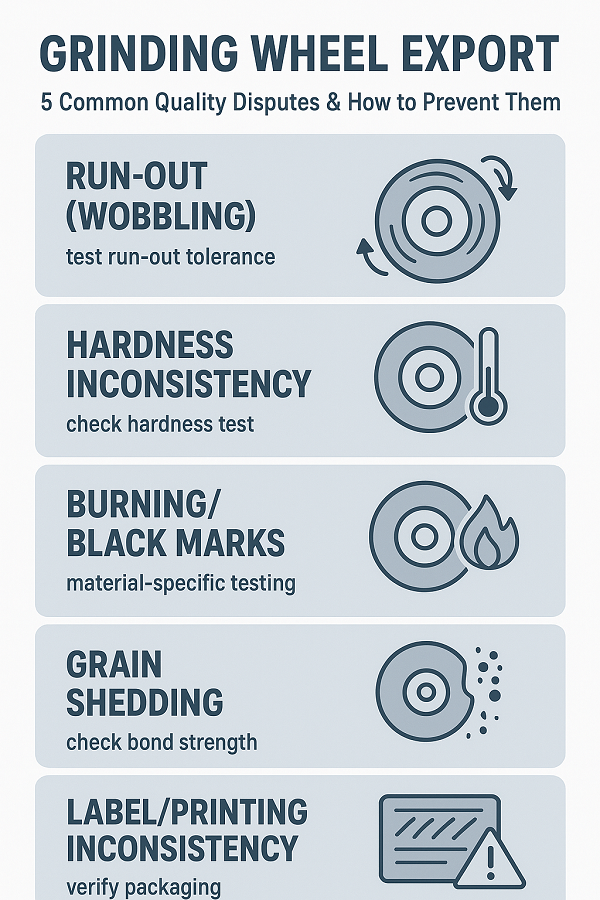
grinding wheels are high-consumption industrial products, and even a small inconsistency can create major complaints in your downstream market. Whether you supply hardware stores, factories, or distributors, avoiding quality disputes is critical for profitability and brand reputation.
Below are the 5 most common quality disputes in grinding wheel exports — and the professional inspection steps to prevent them before shipment.
Typical complaints:
Wheel vibrates during use
Cutting line deviates
Feels unsafe or unstable
Root causes:
Uneven fiber mesh positioning
Poor pressing uniformity
Inaccurate center hole
How importers can inspect:
Ask for run-out tolerance test, typically ≤ 1.5–2.0 mm (depending on diameter)
Check the wheel on a testing mandrel before loading
Require batch consistency photos or videos from the factory
Buyer feedback:
“Some wheels cut fast, some burn the steel.”
“Same box, different performance.”
Root causes:
Resin ratio deviation
Uneven curing temperature
Abrasive material mixing inconsistencies
How to avoid:
Ask for Shore hardness test results per batch
Require same-lot production (no mixing A/B batches)
Confirm the resin brand and percentage in advance
End-user complaints:
Too much heat
Blue/black edges
Cutting speed significantly slower
Root causes:
Wheel too hard for the material
Incorrect abrasive grain size
Inadequate cooling or bond formulation
What buyers should confirm:
Different materials = different wheels
Inox / Stainless Steel → ZA/AO mix, softer bond
Mild Steel → AO, medium bond
Ask for material-specific cutting test videos
Require test data: cutting time, heat marks, burr level
Common results:
Poor lifespan
Unstable performance
High customer complaints
Causes:
Weak resin bonding
Over-firing or under-firing
Low-grade abrasive
Importer checklist:
Request bond strength test (pull test)
Check abrasive grade (A24, A30, A46 etc.)
Visually inspect for uneven surface texture
This often leads to:
Customs delays
Difficult retail sales
Brand-level disputes
How to prevent:
Confirm label template + printing sample before mass production
Require pre-production sample (PPS)
Ask factory to provide packaging line inspection photos
Use this before every order:
Cutting test (material + time + lifespan)
Burr and heat mark evaluation
Hardness test report
Thickness tolerance
Run-out tolerance
Center hole measurement
EN12413 / MPA markings
Ring test
Speed rating verification
Color accuracy
Barcode scanning
Batch traceability
Most grinding wheel disputes are preventable.
As an importer or distributor, the key is:
1 Test by material
2 Verify hardness & consistency
3 Inspect run-out
4 Control packaging & labeling
5 Require test videos + data for every batch
This turns a “high-risk” product into a stable, profitable one — and dramatically reduces customer complaints.
Contact: Emma Wang
Phone: 86-13866745375
E-mail: emma@ramabrasives.com
Whatsapp:+86 18815696540
Add: No.711 Luzhou Avenue,Baohe District,Hefei City,Anhui Province,China
We chat